
If you run a Cash on Delivery (COD) store, you already know the pain: a customer places an order, your team packs it, your courier drives it across town — and then nobody answers the door. The package comes back. You’ve lost the shipping fee both ways, tied up your inventory, and wasted hours of staff time on an order that was never real to begin with.
This is the silent profit killer of COD ecommerce: fake orders and Return to Origin (RTO). And it’s far more common than most store owners realize.
In this guide, we’ll break down exactly why fake orders happen, how they quietly drain your revenue, and — most importantly — the simple fix that stops them before they ever reach your fulfillment team.
If you want to stop fake COD orders WooCommerce stores struggle with every month, you’re not alone — Cash on Delivery fraud quietly drains profits through wasted shipping, lost inventory, and hours of team time on orders that were never real. The good news is that you can stop fake COD orders in WooCommerce with the right verification system in place, and that’s exactly what a dedicated WooCommerce fraud protection plugin like COD Guard from Multi Addons is built to do — turning a checkout that trusts blindly into one that verifies every buyer in real time.
Why Cash on Delivery Attracts Fake Orders
Cash on Delivery is one of the most powerful ways to increase conversions, especially in markets where customers don’t fully trust online prepayment. But it comes with a tradeoff: there’s zero commitment at checkout.
A customer can type in any name, any address, and any phone number, and your store will accept the order without question. That opens the door to:
- Prank or “test” orders — people placing orders out of curiosity with no intent to pay
- Competitor sabotage — rivals flooding your store with fake checkouts to waste your inventory and shipping budget
- Bot and spam checkouts — automated scripts hitting your checkout page repeatedly
- Serial returners — the same problem customers ordering, refusing delivery, and repeating the cycle every month
Every one of these looks identical to a genuine order in your WooCommerce dashboard — until the courier shows up and nobody’s home.
The Real Cost of RTO (Return to Origin)
RTO isn’t just an inconvenience; it’s a direct hit to three areas of your business at once:
- Shipping costs — you pay for the outbound delivery attempt and the return shipment
- Inventory — stock sits in transit or gets damaged in return handling instead of selling to real customers
- Team time — staff spend hours packing, labeling, and following up on orders that were never going to convert
For high-volume COD stores, RTO rates of 20–30% are common — meaning nearly a third of “sales” are actually costing you money instead of making it.
How Fraud Orders Slip Through Standard WooCommerce Checkouts
By default, WooCommerce has no built-in way to confirm that the person placing a COD order is real. There’s no verification step, no accountability, and no way to automatically stop someone who’s already burned you once from ordering again.
Some store owners try manual workarounds — calling every customer before shipping, checking IP addresses, or relying on gut instinct. These approaches don’t scale, waste staff hours, and still let plenty of fraud through, because scammers can easily fake an IP address or simply not answer a confirmation call.
What actually works is putting a real-time verification step directly inside the checkout — before the order is even placed.
The Fix: SMS OTP Verification for Every COD Order
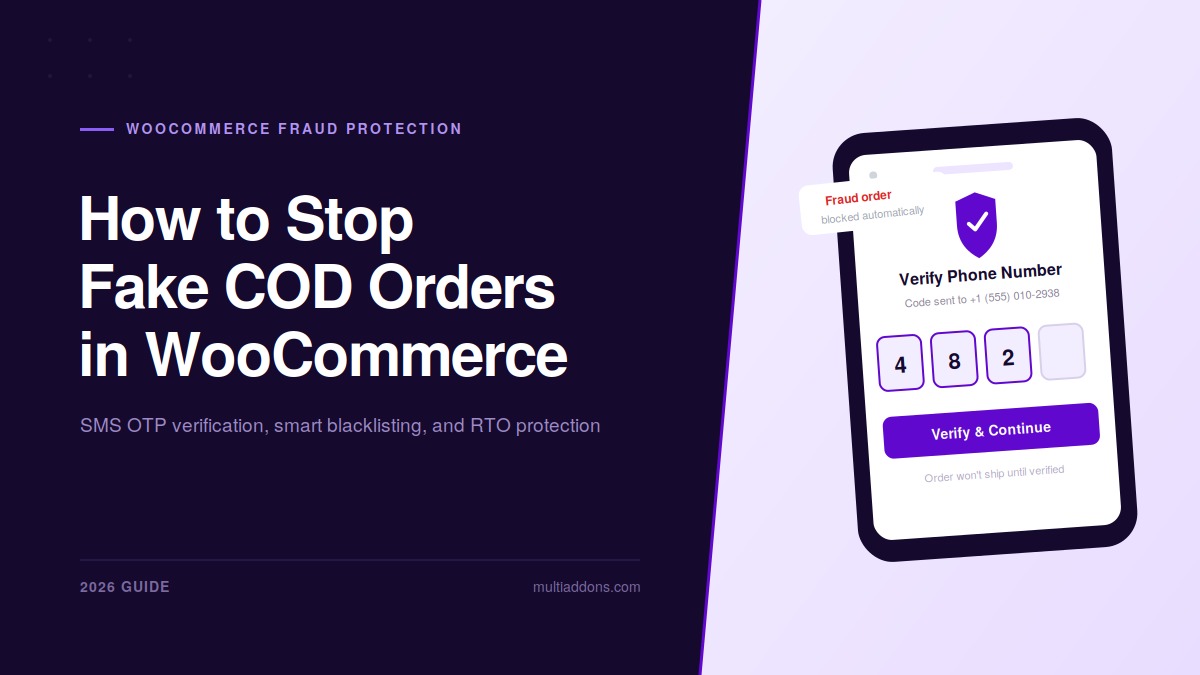
This is where a dedicated fraud protection plugin becomes essential. Instead of trusting whatever a customer types into the checkout form, the store sends a one-time passcode (OTP) via SMS to the phone number entered at checkout. The customer has to enter that code correctly before the order can be completed.
This single step eliminates the vast majority of fake orders, because:
- Fake or mistyped phone numbers instantly fail verification
- Bots and automated scripts can’t complete a real SMS challenge
- Customers who commit to entering a code are far more likely to actually be home for delivery
- Time-limited codes (typically 1–15 minutes) and retry limits stop brute-force attempts
This is exactly the approach used by tools like COD Guard for WooCommerce, which requires mandatory SMS OTP verification specifically for Cash on Delivery checkouts, while leaving prepaid payment methods untouched for a frictionless experience.
Blacklisting Repeat Offenders Automatically
Verification stops new fraud, but what about customers who’ve already burned you? A proper fraud prevention system needs a blacklist, so once a phone number or email is flagged, that customer can never place a COD order again.
The best implementations let you:
- Blacklist by email address or phone number
- Manage the list in one place inside your WooCommerce settings
- Automatically hide the COD payment option the moment a blacklisted customer reaches checkout — no manual review needed
This turns a one-time fraud incident into a permanent, automated block, so your team never has to deal with the same problem customer twice.
Recovering Costs with Smart COD Fees
Even with verification in place, Cash on Delivery inherently carries more logistics risk and cost than prepaid orders. A smart way to offset this is by adding a dynamic COD surcharge — either a flat fee (like $5) or a percentage of the cart total — that only applies when a customer selects Cash on Delivery.
This does two things at once:
- Helps recover part of your shipping and handling risk
- Gently nudges price-sensitive fraud attempts toward prepaid checkout, where fraud risk is much lower
Setting Smart Cart Restrictions
Not every order should even be eligible for Cash on Delivery. High-ticket items, heavy products, or certain categories carry more RTO risk than a $15 accessory. A good fraud protection setup lets you:
- Set minimum and maximum cart value thresholds for COD eligibility
- Block specific products or categories from using COD entirely
- Automatically hide the COD option at checkout the instant a restriction is triggered
This keeps your highest-risk orders on safer, prepaid payment rails, while still offering COD flexibility for lower-risk purchases.
Why COD Guard Is Built for This Exact Problem
If everything above sounds like exactly what your store needs, that’s because it’s precisely what COD Guard for WooCommerce was built to solve. It combines every layer discussed in this article into one plugin:
✅ Mandatory SMS OTP verification for every COD order
✅ Integrations with Twilio, MSG91, and Fast2SMS
✅ Automatic email and phone number blacklisting
✅ Dynamic COD fees (flat or percentage-based)
✅ Cart value, product, and category restrictions for COD eligibility
✅ Full compatibility with both the new Block Checkout and classic Legacy Checkout
✅ HPOS-compatible order status badges, audit logs, and verification history
✅ A built-in test mode so you can try it without spending on SMS credits
Setup takes under five minutes: install the plugin, connect your SMS gateway, enable the features you need, and your store starts filtering out fake orders immediately — no coding required.
If fake orders and RTO losses have been quietly eating into your margins, this is the kind of fix that pays for itself within the first few blocked fraud attempts.
Frequently Asked Questions
What is a fake COD order in WooCommerce?
A fake COD order is any Cash on Delivery checkout placed with false, mistyped, or non-committal customer details — meaning the order was never going to be accepted at delivery. This includes prank orders, bot checkouts, and serial returners.
How does SMS OTP verification prevent fraud?
By requiring customers to enter a one-time code sent to their phone before an order is confirmed, SMS OTP verification confirms the buyer has a real, reachable phone number and genuine intent to purchase — something fake orders almost never survive.
Does blocking fake orders actually reduce RTO?
Yes. Since fake and low-intent orders are the primary driver of Return to Origin shipments, stopping them at checkout — rather than after they’ve already shipped — directly reduces RTO rates and the associated shipping losses.
Will adding OTP verification hurt my checkout conversion rate?
When implemented well, verification only applies to Cash on Delivery — prepaid checkouts remain untouched. Genuine customers complete a quick OTP step in seconds, while it stops the fraudulent orders that were never going to convert into real revenue anyway.
Is this compatible with the new WooCommerce Block Checkout?
Yes, modern fraud protection plugins like COD Guard are built to work natively with both the new WooCommerce Block Checkout and the classic Legacy Checkout, so you don’t need to worry about compatibility issues after updating WordPress or WooCommerce.
Ready to stop losing money to fake orders? Explore COD Guard for WooCommerce and start protecting your checkout today.